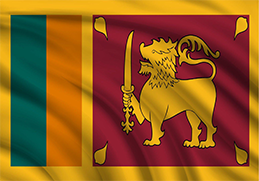
| Official Name: |
Democratic Socialist Republic of Sri Lanka |
| Government Type: |
Republic |
| Location: |
Latitude 5° 55. to 9°50. north, Longitude 79° 42. to 81° 52., 650km north of the equator
|
| Dimensions: |
430km North to South,225km East to West |
| Coastline: |
1,340km |
| Area: |
65,525km |
| Currency (code): |
Sri Lankan Rupee (LKR) |
| Independence: |
4 February 1948 |
| Administrative Capital: |
Sri Jayewardenepura |
| Commercial Capital: |
Colombo |
| AdministrativeDivisions: |
Typically tropical, with a northeast monsoon (December to March) bringing unsettledweather
to the north and east, and a southwest monsoon (June to October)bringing bad weather to the
south and west
|
| Terrain: |
Mostly low, flat torolling plain; mountains in south-central interior |
| Highest Mountain: |
Pidurutalagala, 2,524m |
| Highest Waterfall: |
Bambarakanda, 263m |
| National Flower: |
The Blue Water Lily (Nymphaeastellata) |
| National Parks and Nature Reserves Area: |
8,000sq.km |
| Population: |
22.16 million |
| Population Growth Rate: |
1.3% |
| Population Density: |
309 people per sq km |
| Life Expectancy at Birth: |
74 female, 64 male |
| Literacy Rate : |
Female 87.9 Male 92.5 |
| Ethnic Groups: |
Sinhalese 73.8%, SriLankan Moors 7.2%, Indian Tamil 4.6%, Sri Lankan Tamil 3.9%, other
0.5%,unspecified 10% (2001 census)
|
| Languages: |
Sinhala (official andnational language) 74%, Tamil (national language) 18%, other 8%
Note: English (a link language commonly) is used in government and spokencompetently by
about 10% of the population
|
| Time Zone: |
Sri Lanka StandardTime is five and a half hours ahead of GMT. (Allowance should bemade for
summer-time changes in Europe.)
|
| International Dialing: |
+94 |
| Electricity: |
230 . 240 volts, 50cycles AC. If you travel with a laptop computer bring a stabilizer |
| Economy: |
Sri Lanka’s mostdynamic sectors are food processing, textiles and apparel, food
andbeverages, port construction, telecommunications, insurance and banking. In2006,
plantation crops made up only 15% of exports (90% in 1970), whiletextiles and garments
accounted for more than 60%. About 800,000 Sri Lankanswork abroad, 90% of them in the Middle
East. They send home more than US$1billion a year.
|
| Labour Force: |
34.3% of the labourpopulation is employed in agriculture, 25.3% in industry and 40.4%
inservices: 40.4% (30 June 2006 est.) The unemployment rate is 5.7% (2007 est.)
|
| Agriculture & Products: |
Rice, Sugarcane,Grains, Pulses, Oilseed, Spices, Tea, Rubber, Coconuts, milk, Eggs,
Hides,Beef, Fish
|
| Industries: |
Processing of rubber,tea, coconuts, tobacco and other agricultural
commodities,telecommunications, insurance, banking; clothing, textiles, cement,
petroleumrefining.
|
| Exports: |
Textiles and apparel;tea and spices; diamonds, emeralds, rubies; coconut products,
rubbermanufactures, fish
|
| Imports: |
Main importcommodities are textile fabrics, mineral products, petroleum, food
stuffs,machinery and transportation equipment: $10.61 billion f.o.b. (2007 est.).Percentage
of main commodities from main import partners: India 19.6%, China10.5%, Singapore 8.8%, Iran
5.7%, Malaysia 5.1%, Hong Kong 4.2%, Japan 4.1%(2006)
|
| Gross Domestic Product(GDP): |
The Gross Domestic Product (GDP) in Sri Lanka was worth 88.93 billion US dollars in 2021, according to official data from the World Bank. The GDP value of Sri Lanka represents 0.04 percent of the world economy
|
| Gross National Product(GNP): |
Gross National Product in Sri Lanka increased to 16,402,705 LKR Million in 2021 from 14,567,811 LKR Million in 2020
|